Wir wollen uns eine einfache Rechenvorschrift anschauen, die wir auf eine positive Zahl anwenden wollen:
Game of life ist ein sogenannter zellulärer Automat. Wir haben ein Spielfeld, das aus Zellen besteht. Eine Zelle kann entweder tot sein oder leben. Jede Zelle hat acht Nachbarzellen. Die Randzellen werden als grundsätzlich tot definiert.
Es gibt drei Regeln, die über Leben und Tod entscheiden:
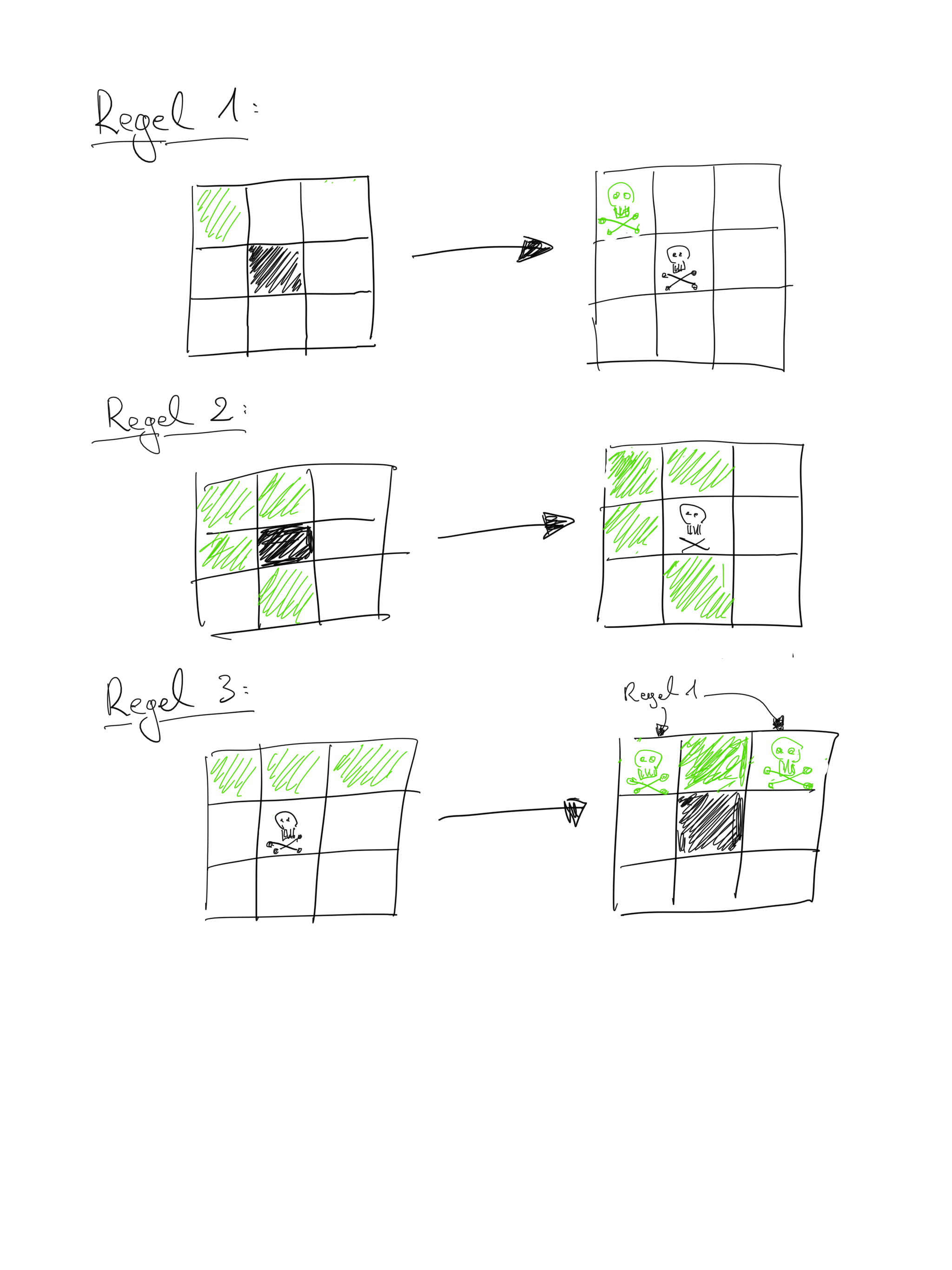 ",
code: {
name: "GameOfLife",
code: ["public class GameOfLife {",
" /*",
" * Gibt 0 zurueck, falls die Zelle in der naechsten Generation tot sein soll",
" * Gibt 1 zurueck, falls die Zelle in der naechsten Generation lebendig sein soll",
" */",
" public static int spielregel(int nachbarn, int aktiv) {",
" return -1;",
" }",
"",
" /*",
" * Gibt die Anzahl der Nachbarn der Zelle an Position zeile, spalte in dem",
" * Array board zurueck.",
" */",
" public static int zaehleLebendeNachbarn(int[][] board, int zeile, int spalte) {",
" return -1;",
" }",
"",
"",
" /* Ausgehend von dem Array board wird ein Schritt berechnet.",
" * Hinweis: Alle Randzellen sind immer 0",
" */",
" public static int[][] berechneNaechsteGeneration(int[][] board) {",
" return board;",
" }",
"}"]
},
test: {
name: "GameOfLifeTest",
code: ["import static org.junit.Assert.*;",
"import org.junit.*;",
"",
"public class GameOfLifeTest {",
"",
" @Ignore",
" @Test",
" public void einsameZellenSterbenKeineNachbarn() throws Exception {",
" assertEquals(0, GameOfLife.spielregel(0, 1));",
" }",
"",
" @Ignore",
" @Test",
" public void toteZellenMitDreiNachbarnWerdenLebendig() throws Exception {",
" assertEquals(1, GameOfLife.spielregel(3, 0));",
" }",
"",
" @Ignore",
" @Test",
" public void lebendeZellenMitZweiNachbarnBleibenLebendig() throws Exception {",
" assertEquals(1, GameOfLife.spielregel(2, 1));",
" }",
" @Ignore",
" @Test",
" public void toteZellenMitZweiNachbarnBleibenTot() throws Exception {",
" assertEquals(0, GameOfLife.spielregel(2, 0));",
" }",
"",
" @Ignore",
" @Test",
" public void toteZellenOhneNachbarnBleibenTot() throws Exception {",
" assertEquals(0, GameOfLife.spielregel(0, 0));",
" }",
"",
" // Folgende Tests sind zur Sicherheit, sie sollten nun alle laufen.",
" // Entfernen Sie den Blockkommentar und pruefen Sie ob alles laeuft.",
"",
"/* ",
"",
" @Test",
" public void einsameZellenSterbenEinNachbar() throws Exception {",
" assertEquals(0, GameOfLife.spielregel(1, 1));",
" }",
"",
" @Test",
" public void zellenMitVierNachbarnSterben() throws Exception {",
" assertEquals(0, GameOfLife.spielregel(4, 1));",
" }",
"",
" @Test",
" public void zellenMitFuenfNachbarnSterben() throws Exception {",
" assertEquals(0, GameOfLife.spielregel(5, 1));",
" }",
"",
" @Test",
" public void zellenMitSechsNachbarnSterben() throws Exception {",
" assertEquals(0, GameOfLife.spielregel(6, 1));",
" }",
"",
" @Test",
" public void zellenMitSiebenNachbarnSterben() throws Exception {",
" assertEquals(0, GameOfLife.spielregel(7, 1));",
" }",
"",
" @Test",
" public void zellenMitAchtNachbarnSterben() throws Exception {",
" assertEquals(0, GameOfLife.spielregel(8, 1));",
" }",
"",
" @Test",
" public void toteZellenMitEinemNachbarnBleibenTot() throws Exception {",
" assertEquals(0, GameOfLife.spielregel(1, 0));",
" }",
"",
"",
" @Test",
" public void lebendeZellenMitDreiNachbarnBleibenLebendig() throws Exception {",
" assertEquals(1, GameOfLife.spielregel(3, 1));",
" }",
"",
" @Test",
" public void toteZellenMitVierNachbarnBleibenTot() throws Exception {",
" assertEquals(0, GameOfLife.spielregel(4, 0));",
" }",
"",
" @Test",
" public void toteZellenMitFuenfNachbarnBleibenTot() throws Exception {",
" assertEquals(0, GameOfLife.spielregel(5, 0));",
" }",
"",
" @Test",
" public void toteZellenMitSechsNachbarnBleibenTot() throws Exception {",
" assertEquals(0, GameOfLife.spielregel(6, 0));",
" }",
"",
" @Test",
" public void toteZellenMitSiebenNachbarnBleibenTot() throws Exception {",
" assertEquals(0, GameOfLife.spielregel(7, 0));",
" } ",
"",
" @Test",
" public void toteZellenMitAchtNachbarnBleibenTot() throws Exception {",
" assertEquals(0, GameOfLife.spielregel(8, 0));",
" } ",
" */",
"",
" @Ignore",
" @Test",
" public void keineNachbarn() {",
" int lebendeNachbarn = GameOfLife",
" .zaehleLebendeNachbarn(new int[][] {",
" { 0, 0, 0, 0 },",
" { 0, 0, 0, 0 },",
" { 0, 0, 0, 1 }},",
" 1,1); /* 2. Zeile, 2. Spalte */",
" assertEquals(0, lebendeNachbarn);",
" }",
"",
" @Ignore",
" @Test",
" public void einNachbar() {",
" int lebendeNachbarn = GameOfLife",
" .zaehleLebendeNachbarn(new int[][] {",
" { 0, 0, 0, 0 },",
" { 0, 0, 0, 0 },",
" { 0, 0, 0, 1 } }, 1, 2); /* 2. Zeile, 3. Spalte */",
" assertEquals(1, lebendeNachbarn);",
" }",
"",
" @Ignore",
" @Test",
" public void einNachbarUndEineEntfernteZelle() {",
" int lebendeNachbarn = GameOfLife",
" .zaehleLebendeNachbarn(new int[][] {",
" { 1, 0, 0, 0 },",
" { 0, 0, 0, 0 },",
" { 0, 0, 0, 1 } }, 1, 2); ",
" assertEquals(1, lebendeNachbarn);",
" }",
"",
" @Ignore",
" @Test",
" public void vierNachbarnEinerInaktivenZelle() {",
" int lebendeNachbarn = GameOfLife",
" .zaehleLebendeNachbarn(new int[][] {",
" { 1, 0, 1, 0 },",
" { 0, 0, 0, 1 },",
" { 0, 1, 0, 1 } }, 1, 2);",
" assertEquals(4, lebendeNachbarn);",
" }",
"",
" @Ignore",
" @Test",
" public void vierNachbarnEinerAktivenZelle() {",
" int lebendeNachbarn = GameOfLife",
" .zaehleLebendeNachbarn(new int[][] {",
" { 1, 0, 1, 0 },",
" { 0, 0, 1, 1 },",
" { 0, 1, 0, 1 } }, 1, 2);",
" assertEquals(4, lebendeNachbarn);",
" }",
"",
" @Ignore",
" @Test",
" public void achtNachbarnEinerAktivenZelle() {",
" int lebendeNachbarn = GameOfLife",
" .zaehleLebendeNachbarn(new int[][] {",
" { 1, 1, 1, 1 },",
" { 0, 1, 1, 1 },",
" { 0, 1, 1, 1 } }, 1, 2);",
" assertEquals(8, lebendeNachbarn);",
" }",
"",
" @Ignore",
" @Test",
" public void achtNachbarnEinerInaktivenZelle() {",
" int lebendeNachbarn = GameOfLife",
" .zaehleLebendeNachbarn(new int[][] {",
" { 1, 1, 1, 1 },",
" { 0, 1, 0, 1 },",
" { 0, 1, 1, 1 } }, 1, 2);",
" assertEquals(8, lebendeNachbarn);",
" }",
"",
" /* Randzellen sind immer tot! */",
"",
" @Ignore",
" @Test",
" public void simpleGen1() throws Exception {",
" int[][] input = {",
" { 0, 0, 0, 0, 0 },",
" { 0, 1, 0, 0, 0 },",
" { 0, 0, 0, 0, 0 },",
" { 0, 0, 0, 0, 0 },",
" { 0, 0, 0, 0, 0 } };",
" int[][] output = {",
" { 0, 0, 0, 0, 0 },",
" { 0, 0, 0, 0, 0 },",
" { 0, 0, 0, 0, 0 },",
" { 0, 0, 0, 0, 0 },",
" { 0, 0, 0, 0, 0 } };",
" checkBoard(GameOfLife.berechneNaechsteGeneration(input), output);",
" }",
"",
" @Ignore",
" @Test",
" public void simpleGen2() throws Exception {",
" int[][] input = {",
" { 0, 0, 0, 0, 0 },",
" { 0, 1, 1, 0, 0 },",
" { 0, 1, 1, 0, 0 },",
" { 0, 0, 0, 0, 0 },",
" { 0, 0, 0, 0, 0 } };",
" int[][] output = {",
" { 0, 0, 0, 0, 0 },",
" { 0, 1, 1, 0, 0 },",
" { 0, 1, 1, 0, 0 },",
" { 0, 0, 0, 0, 0 },",
" { 0, 0, 0, 0, 0 } };",
" checkBoard(GameOfLife.berechneNaechsteGeneration(input), output);",
" }",
"",
" @Ignore",
" @Test",
" public void simpleGen3() throws Exception {",
" int[][] input = {",
" { 0, 0, 0, 0, 0 },",
" { 0, 0, 1, 0, 0 },",
" { 0, 0, 0, 1, 0 },",
" { 0, 1, 1, 1, 0 },",
" { 0, 0, 0, 0, 0 } };",
" int[][] output = {",
" { 0, 0, 0, 0, 0 },",
" { 0, 0, 0, 0, 0 },",
" { 0, 1, 0, 1, 0 },",
" { 0, 0, 1, 1, 0 },",
" { 0, 0, 0, 0, 0 } };",
" checkBoard(GameOfLife.berechneNaechsteGeneration(input), output);",
" }",
"",
" @Ignore",
" @Test",
" public void simpleGen4() throws Exception {",
" int[][] input = {",
" { 0, 0, 0, 0, 0, 0 },",
" { 0, 0, 1, 1, 0, 0 },",
" { 0, 0, 0, 1, 1, 0 },",
" { 0, 1, 1, 1, 0, 0 },",
" { 0, 0, 0, 0, 0, 0 } };",
" int[][] output = {",
" { 0, 0, 0, 0, 0, 0 },",
" { 0, 0, 1, 1, 1, 0 },",
" { 0, 1, 0, 0, 1, 0 },",
" { 0, 0, 1, 1, 1, 0 },",
" { 0, 0, 0, 0, 0, 0 } };",
" checkBoard(GameOfLife.berechneNaechsteGeneration(input), output);",
" }",
"",
"",
" private void checkBoard(int[][] output, int[][] input) {",
" assertEquals(input.length, output.length);",
" for (int i = 0; i < output.length; i++) {",
" assertArrayEquals(output[i], input[i]);",
" }",
" }",
"",
"}"
]
},
babyStepsActivated: false,
retrospective: false
},
{
name: "Römische Zahlen Ping Pong",
description: "
",
code: {
name: "GameOfLife",
code: ["public class GameOfLife {",
" /*",
" * Gibt 0 zurueck, falls die Zelle in der naechsten Generation tot sein soll",
" * Gibt 1 zurueck, falls die Zelle in der naechsten Generation lebendig sein soll",
" */",
" public static int spielregel(int nachbarn, int aktiv) {",
" return -1;",
" }",
"",
" /*",
" * Gibt die Anzahl der Nachbarn der Zelle an Position zeile, spalte in dem",
" * Array board zurueck.",
" */",
" public static int zaehleLebendeNachbarn(int[][] board, int zeile, int spalte) {",
" return -1;",
" }",
"",
"",
" /* Ausgehend von dem Array board wird ein Schritt berechnet.",
" * Hinweis: Alle Randzellen sind immer 0",
" */",
" public static int[][] berechneNaechsteGeneration(int[][] board) {",
" return board;",
" }",
"}"]
},
test: {
name: "GameOfLifeTest",
code: ["import static org.junit.Assert.*;",
"import org.junit.*;",
"",
"public class GameOfLifeTest {",
"",
" @Ignore",
" @Test",
" public void einsameZellenSterbenKeineNachbarn() throws Exception {",
" assertEquals(0, GameOfLife.spielregel(0, 1));",
" }",
"",
" @Ignore",
" @Test",
" public void toteZellenMitDreiNachbarnWerdenLebendig() throws Exception {",
" assertEquals(1, GameOfLife.spielregel(3, 0));",
" }",
"",
" @Ignore",
" @Test",
" public void lebendeZellenMitZweiNachbarnBleibenLebendig() throws Exception {",
" assertEquals(1, GameOfLife.spielregel(2, 1));",
" }",
" @Ignore",
" @Test",
" public void toteZellenMitZweiNachbarnBleibenTot() throws Exception {",
" assertEquals(0, GameOfLife.spielregel(2, 0));",
" }",
"",
" @Ignore",
" @Test",
" public void toteZellenOhneNachbarnBleibenTot() throws Exception {",
" assertEquals(0, GameOfLife.spielregel(0, 0));",
" }",
"",
" // Folgende Tests sind zur Sicherheit, sie sollten nun alle laufen.",
" // Entfernen Sie den Blockkommentar und pruefen Sie ob alles laeuft.",
"",
"/* ",
"",
" @Test",
" public void einsameZellenSterbenEinNachbar() throws Exception {",
" assertEquals(0, GameOfLife.spielregel(1, 1));",
" }",
"",
" @Test",
" public void zellenMitVierNachbarnSterben() throws Exception {",
" assertEquals(0, GameOfLife.spielregel(4, 1));",
" }",
"",
" @Test",
" public void zellenMitFuenfNachbarnSterben() throws Exception {",
" assertEquals(0, GameOfLife.spielregel(5, 1));",
" }",
"",
" @Test",
" public void zellenMitSechsNachbarnSterben() throws Exception {",
" assertEquals(0, GameOfLife.spielregel(6, 1));",
" }",
"",
" @Test",
" public void zellenMitSiebenNachbarnSterben() throws Exception {",
" assertEquals(0, GameOfLife.spielregel(7, 1));",
" }",
"",
" @Test",
" public void zellenMitAchtNachbarnSterben() throws Exception {",
" assertEquals(0, GameOfLife.spielregel(8, 1));",
" }",
"",
" @Test",
" public void toteZellenMitEinemNachbarnBleibenTot() throws Exception {",
" assertEquals(0, GameOfLife.spielregel(1, 0));",
" }",
"",
"",
" @Test",
" public void lebendeZellenMitDreiNachbarnBleibenLebendig() throws Exception {",
" assertEquals(1, GameOfLife.spielregel(3, 1));",
" }",
"",
" @Test",
" public void toteZellenMitVierNachbarnBleibenTot() throws Exception {",
" assertEquals(0, GameOfLife.spielregel(4, 0));",
" }",
"",
" @Test",
" public void toteZellenMitFuenfNachbarnBleibenTot() throws Exception {",
" assertEquals(0, GameOfLife.spielregel(5, 0));",
" }",
"",
" @Test",
" public void toteZellenMitSechsNachbarnBleibenTot() throws Exception {",
" assertEquals(0, GameOfLife.spielregel(6, 0));",
" }",
"",
" @Test",
" public void toteZellenMitSiebenNachbarnBleibenTot() throws Exception {",
" assertEquals(0, GameOfLife.spielregel(7, 0));",
" } ",
"",
" @Test",
" public void toteZellenMitAchtNachbarnBleibenTot() throws Exception {",
" assertEquals(0, GameOfLife.spielregel(8, 0));",
" } ",
" */",
"",
" @Ignore",
" @Test",
" public void keineNachbarn() {",
" int lebendeNachbarn = GameOfLife",
" .zaehleLebendeNachbarn(new int[][] {",
" { 0, 0, 0, 0 },",
" { 0, 0, 0, 0 },",
" { 0, 0, 0, 1 }},",
" 1,1); /* 2. Zeile, 2. Spalte */",
" assertEquals(0, lebendeNachbarn);",
" }",
"",
" @Ignore",
" @Test",
" public void einNachbar() {",
" int lebendeNachbarn = GameOfLife",
" .zaehleLebendeNachbarn(new int[][] {",
" { 0, 0, 0, 0 },",
" { 0, 0, 0, 0 },",
" { 0, 0, 0, 1 } }, 1, 2); /* 2. Zeile, 3. Spalte */",
" assertEquals(1, lebendeNachbarn);",
" }",
"",
" @Ignore",
" @Test",
" public void einNachbarUndEineEntfernteZelle() {",
" int lebendeNachbarn = GameOfLife",
" .zaehleLebendeNachbarn(new int[][] {",
" { 1, 0, 0, 0 },",
" { 0, 0, 0, 0 },",
" { 0, 0, 0, 1 } }, 1, 2); ",
" assertEquals(1, lebendeNachbarn);",
" }",
"",
" @Ignore",
" @Test",
" public void vierNachbarnEinerInaktivenZelle() {",
" int lebendeNachbarn = GameOfLife",
" .zaehleLebendeNachbarn(new int[][] {",
" { 1, 0, 1, 0 },",
" { 0, 0, 0, 1 },",
" { 0, 1, 0, 1 } }, 1, 2);",
" assertEquals(4, lebendeNachbarn);",
" }",
"",
" @Ignore",
" @Test",
" public void vierNachbarnEinerAktivenZelle() {",
" int lebendeNachbarn = GameOfLife",
" .zaehleLebendeNachbarn(new int[][] {",
" { 1, 0, 1, 0 },",
" { 0, 0, 1, 1 },",
" { 0, 1, 0, 1 } }, 1, 2);",
" assertEquals(4, lebendeNachbarn);",
" }",
"",
" @Ignore",
" @Test",
" public void achtNachbarnEinerAktivenZelle() {",
" int lebendeNachbarn = GameOfLife",
" .zaehleLebendeNachbarn(new int[][] {",
" { 1, 1, 1, 1 },",
" { 0, 1, 1, 1 },",
" { 0, 1, 1, 1 } }, 1, 2);",
" assertEquals(8, lebendeNachbarn);",
" }",
"",
" @Ignore",
" @Test",
" public void achtNachbarnEinerInaktivenZelle() {",
" int lebendeNachbarn = GameOfLife",
" .zaehleLebendeNachbarn(new int[][] {",
" { 1, 1, 1, 1 },",
" { 0, 1, 0, 1 },",
" { 0, 1, 1, 1 } }, 1, 2);",
" assertEquals(8, lebendeNachbarn);",
" }",
"",
" /* Randzellen sind immer tot! */",
"",
" @Ignore",
" @Test",
" public void simpleGen1() throws Exception {",
" int[][] input = {",
" { 0, 0, 0, 0, 0 },",
" { 0, 1, 0, 0, 0 },",
" { 0, 0, 0, 0, 0 },",
" { 0, 0, 0, 0, 0 },",
" { 0, 0, 0, 0, 0 } };",
" int[][] output = {",
" { 0, 0, 0, 0, 0 },",
" { 0, 0, 0, 0, 0 },",
" { 0, 0, 0, 0, 0 },",
" { 0, 0, 0, 0, 0 },",
" { 0, 0, 0, 0, 0 } };",
" checkBoard(GameOfLife.berechneNaechsteGeneration(input), output);",
" }",
"",
" @Ignore",
" @Test",
" public void simpleGen2() throws Exception {",
" int[][] input = {",
" { 0, 0, 0, 0, 0 },",
" { 0, 1, 1, 0, 0 },",
" { 0, 1, 1, 0, 0 },",
" { 0, 0, 0, 0, 0 },",
" { 0, 0, 0, 0, 0 } };",
" int[][] output = {",
" { 0, 0, 0, 0, 0 },",
" { 0, 1, 1, 0, 0 },",
" { 0, 1, 1, 0, 0 },",
" { 0, 0, 0, 0, 0 },",
" { 0, 0, 0, 0, 0 } };",
" checkBoard(GameOfLife.berechneNaechsteGeneration(input), output);",
" }",
"",
" @Ignore",
" @Test",
" public void simpleGen3() throws Exception {",
" int[][] input = {",
" { 0, 0, 0, 0, 0 },",
" { 0, 0, 1, 0, 0 },",
" { 0, 0, 0, 1, 0 },",
" { 0, 1, 1, 1, 0 },",
" { 0, 0, 0, 0, 0 } };",
" int[][] output = {",
" { 0, 0, 0, 0, 0 },",
" { 0, 0, 0, 0, 0 },",
" { 0, 1, 0, 1, 0 },",
" { 0, 0, 1, 1, 0 },",
" { 0, 0, 0, 0, 0 } };",
" checkBoard(GameOfLife.berechneNaechsteGeneration(input), output);",
" }",
"",
" @Ignore",
" @Test",
" public void simpleGen4() throws Exception {",
" int[][] input = {",
" { 0, 0, 0, 0, 0, 0 },",
" { 0, 0, 1, 1, 0, 0 },",
" { 0, 0, 0, 1, 1, 0 },",
" { 0, 1, 1, 1, 0, 0 },",
" { 0, 0, 0, 0, 0, 0 } };",
" int[][] output = {",
" { 0, 0, 0, 0, 0, 0 },",
" { 0, 0, 1, 1, 1, 0 },",
" { 0, 1, 0, 0, 1, 0 },",
" { 0, 0, 1, 1, 1, 0 },",
" { 0, 0, 0, 0, 0, 0 } };",
" checkBoard(GameOfLife.berechneNaechsteGeneration(input), output);",
" }",
"",
"",
" private void checkBoard(int[][] output, int[][] input) {",
" assertEquals(input.length, output.length);",
" for (int i = 0; i < output.length; i++) {",
" assertArrayEquals(output[i], input[i]);",
" }",
" }",
"",
"}"
]
},
babyStepsActivated: false,
retrospective: false
},
{
name: "Römische Zahlen Ping Pong",
description: "Die Methode convert soll implementiert werden. Sie bekommt eine ganze Zahl zwischen 1 und 50 übergeben und gibt die Darstellung der Zahl im römischen Zahlensystem aus. Für ungültige Eingaben soll der leere String zurückgegeben werden.
Die Zahlzeichen des römischen Ziffersystems sind: I (1), V (5) X (10) und 50 (L). Es werden höchstens drei gleiche Ziffern hintereinander geschreiben, dann greift die Subtraktionsregel, d.h. Es kann ein einzelnes I vor ein V oder ein X, bzw. ein einzelnes X vor ein L geschrieben werden. Die Subraktionsregel liefert also zum Beispiel die Zahlen 4 (IV), 9 (IX), 40 (XL).
Einige weitere Beispiele: 14 = 10 + 4 (XIV), 39 = 30 + 9 (XXXIX), 44 = 40 + 4 (XLIV).
", code: { name: "RomanNumbers", code: ["public class RomanNumbers {", " ", " public String convert(int n) {", " return \"I am groot.\";", " }", "", "}"] }, test: { name: "RomanNumbersTest", code: ["import static org.junit.Assert.*;", "import org.junit.*;", "", "public class RomanNumbersTest {", "", "", " @Test", " public void someTest() {", " assertEquals(1, 1); // Replace me", " }", "", "}"] }, babyStepsActivated: false, retrospective: false } ]